

GMC Terrain vs. GMC Acadia: Which GMC SUV Is Right for Your Family?
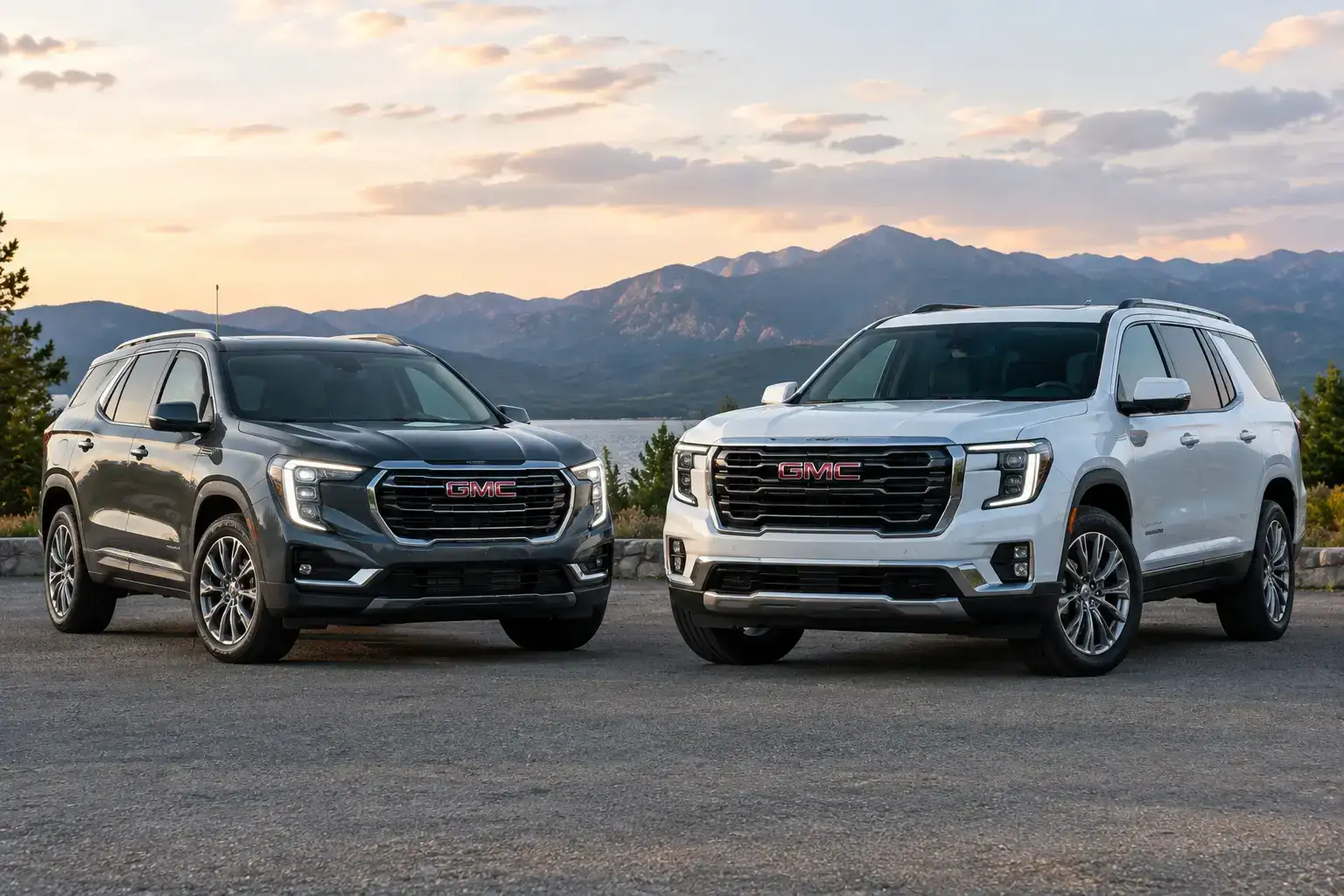
GMC offers two SUVs that sit right in the middle of most families’ needs: the Terrain and the Acadia. They share a brand, a design language, and a commitment to the premium truck-adjacent experience that GMC has built over decades. Beyond those shared traits, they are fundamentally different vehicles designed for different buyers with different priorities.
This guide breaks down the Terrain and Acadia across every dimension that matters to a family making this decision: size, passenger capacity, engine performance, fuel economy, towing capability, technology, and price. By the end, you will have a clear picture of which vehicle fits your life, and why.
Size and Passenger Capacity: The Core Difference
The single most important difference between the Terrain and the Acadia is size, and size determines passenger capacity. The 2026 GMC Terrain is a compact two-row SUV with seating for five passengers. It is the right size for couples, small families, or any household where five seats is enough and manageable dimensions matter in parking lots, narrow driveways, and urban driving.
The 2026 GMC Acadia is a midsize three-row SUV with seating for up to eight passengers. It is approximately 23 inches longer than the Terrain, a measurement that translates directly into the additional passenger and cargo space the third row requires. For families with three or more children, for households that regularly carpool, or for any buyer who needs to seat more than five people on a regular basis, the Acadia’s third row moves it from an option into a requirement.
The Acadia’s third row is also meaningful for occasionally larger groups. Even buyers who typically travel as a family of four or five appreciate the third row when extended family visits, sports team transportation, or road trips with additional passengers arise. Having the capacity when you need it, without the hassle of renting a van or taking two vehicles, is a practical benefit that the Terrain simply cannot provide.
Engine and Performance
The powertrain difference between the Terrain and Acadia is substantial. The 2026 GMC Terrain uses a 1.5L turbocharged four-cylinder engine producing 175 horsepower. This is adequate power for daily driving, highway merging, and the kind of suburban and light highway use that the Terrain is designed for. It is not a vehicle that inspires with its acceleration, and buyers who come from a V6 or turbocharged engine background will notice the difference.
The 2026 GMC Acadia uses a 2.5L turbocharged four-cylinder engine producing 328 horsepower and 326 lb-ft of torque. This is a genuinely strong engine that puts the Acadia’s performance comfortably above the Terrain in every real-world driving scenario. Highway passing is confident, freeway on-ramps are easy to navigate fully loaded, and the Acadia does not feel strained at the weights it carries with a full passenger load.
The 87-horsepower difference between the two engines is large in real-world terms. If you regularly drive with a full load of passengers, frequently merge onto Florida’s busy interstates, or simply prefer an SUV that responds with authority when you need it, the Acadia’s powertrain is the meaningfully better experience. The Terrain’s engine is appropriate for its size and typical use case; the Acadia’s engine is appropriate for a vehicle that weighs more and carries more people.
Fuel Economy
The Terrain’s smaller engine and lighter weight translate into better fuel economy numbers. The 2026 Terrain delivers approximately 27 MPG combined, making it one of the more efficient options in its competitive set. For buyers who commute daily and track their fuel costs carefully, the Terrain’s efficiency is a genuine advantage over the course of a year of ownership.
The 2026 Acadia delivers approximately 22 MPG combined. This is respectable for a three-row midsize SUV with 328 horsepower, but it is five MPG lower than the Terrain. Over 15,000 miles of driving per year, that difference amounts to roughly 125 additional gallons of fuel consumed, which at Florida gas prices represents a meaningful annual operating cost difference.
The fuel economy comparison needs to be understood in context: the Acadia carries more people more comfortably and with more power. If you are filling the Acadia’s eight seats regularly and the alternative is running two vehicles to move the same group, the fuel economy math shifts entirely in the Acadia’s favor. The efficiency comparison is most meaningful for buyers who are genuinely on the fence between the two vehicles’ size categories and for whom fuel cost is a primary decision factor.
Towing Capability
Towing capacity is another area where the Acadia substantially outpaces the Terrain. The 2026 Acadia is rated to tow up to 5,000 pounds when properly equipped, enough for a mid-size boat, a jet ski pair on a double trailer, a small horse trailer, or a loaded utility trailer for a home project or move. For Central Florida buyers who use their SUV to access the chain of lakes or to haul equipment, 5,000 pounds opens a meaningful range of real-world uses.
The 2026 Terrain is rated to tow up to 1,500 pounds. This covers light-duty tasks, a small utility trailer, or a personal watercraft on a basic trailer, but it does not reach the threshold that most recreational boat trailers require. If towing is any part of how you plan to use your SUV, the Terrain’s limit is a practical constraint that most Florida families will feel.
The difference in towing capacity between the two, 1,500 pounds versus 5,000 pounds, is large enough to matter in most real purchase decisions. If you have a boat, plan to get one, or regularly tow anything of substance, the Acadia’s capability is not a marginal upgrade. It is the difference between an SUV that can do the job and one that cannot.
Safety Ratings and Driver Assistance
Safety ratings are a meaningful consideration for family SUV buyers, and both the Terrain and Acadia carry strong safety credentials. The 2026 GMC Acadia earned an IIHS Top Safety Pick designation, which reflects strong performance across frontal, side, and rear crash tests along with headlight evaluations. This rating is relevant for families who prioritize independent safety verification beyond manufacturer claims.
Both vehicles come equipped with GMC’s standard suite of active safety technology, including forward collision alert, automatic emergency braking, lane keep assist, and a following distance indicator. These systems are active at the lower trim levels, which means buyers do not have to choose a higher-priced trim to access the core active safety features. For families with newer drivers, the availability of these systems across the lineup is a meaningful advantage.
The Terrain’s compact footprint also contributes to its ease of handling in tight situations, which is its own form of active safety for drivers navigating crowded parking lots, school pick-up lines, and the narrow lanes that appear regularly in older Central Florida neighborhoods and commercial areas. Maneuverability is a real-world safety factor that specification sheets do not capture.
Drivetrain Options: FWD and AWD
Both the Terrain and Acadia are available with front-wheel drive as the standard drivetrain and all-wheel drive as an available upgrade. For Central Florida buyers, front-wheel drive is the practical choice for most conditions, as AWD provides its primary benefit in snow, ice, and low-traction situations that are rare in this region. AWD adds cost and very slightly reduces fuel economy.
The exception is buyers who use their SUV for off-road or trail driving. For those buyers, AWD on either the Terrain or Acadia provides better traction on loose sand, mud, or uneven terrain, which is relevant for Central Florida’s off-road parks and state forest trails. If occasional light off-road use is part of your driving profile, AWD is worth the upgrade. If your driving is entirely on paved roads, FWD delivers equivalent day-to-day performance at a lower price.
Technology and Features
Both the Terrain and Acadia reflect GMC’s commitment to genuine technology content across their lineups. Both vehicles are available with wireless Apple CarPlay and Android Auto, a range of driver assistance systems, and GMC’s current infotainment platform. The differences in technology become more pronounced as you move up the trim ladders of each vehicle.
The Acadia Denali Ultimate, at $63,100, brings available Super Cruise hands-free driver assistance to the three-row SUV segment, making it one of the few vehicles in this class with factory hands-free highway driving. It also offers a larger infotainment display and a more extensively equipped interior. The Terrain Denali, at $41,900, is a genuinely well-equipped vehicle but does not offer Super Cruise at any trim level.
For technology buyers who want Super Cruise, the Acadia offers it across the lineup: standard on the Denali Ultimate and available as a paid option on the Elevation, AT4 and Denali. That makes the Acadia the only GMC SUV below the Yukon where hands-free highway driving is on the table at any trim, and the Elevation with the Super Cruise option is the least expensive way into it.
Pricing: Terrain vs. Acadia Across Trims
| Trim | Terrain | Acadia |
| Elevation (base) | $30,200 | $43,800 |
| AT4 | $39,400 | $52,500 |
| Denali | $41,900 | $55,900 |
| Denali Ultimate | N/A | $63,100 |
The price gap between equivalent Terrain and Acadia trims runs approximately $12,000 to $13,000. Whether that gap is justified depends entirely on whether you need what the Acadia provides that the Terrain does not: the third row, the additional power, and the higher towing capacity. If you need those things, the Acadia’s premium is the cost of the capability. If you do not, the Terrain’s lower entry point and better fuel economy make it the more efficient choice.
Which One Should You Choose?
Choose the Terrain if: your household regularly carries five or fewer passengers, you prioritize fuel economy and lower running costs, your daily driving is primarily suburban and urban with minimal towing needs, or your budget points toward the compact SUV category and the Terrain’s capabilities cover your real-world requirements.
Choose the Acadia if: you have or plan to have three or more children, you regularly transport more than five people, towing a boat, jet skis, or a trailer is part of your life, you want the most powerful engine available in a midsize GMC SUV, or Super Cruise hands-free driver assistance is a priority for your next vehicle.
For many Central Florida families, the answer comes down to the third row. If you need it, the Acadia is the answer. If you do not, the Terrain delivers the GMC experience in a more efficient and more affordable package. Both vehicles are strong in their respective categories, and both are available at St. Cloud GMC with September incentives that make this the right time to buy.
Visit St. Cloud GMC to Compare Both Models
The most useful thing you can do before choosing between the Terrain and Acadia is drive both. The size difference that looks abstract on a spec sheet becomes immediately tangible behind the wheel and in the parking lot. Our St. Cloud team can arrange back-to-back drives in both vehicles and walk you through the exact trim and option combinations that fit your budget and feature requirements.
We serve buyers from throughout Osceola County, Kissimmee, Celebration, and across greater Central Florida. Visit our dealership, browse our current Terrain and Acadia inventory online, or contact our team with your specific questions. We will help you arrive at the right decision with full information.
Conclusion
The Terrain and the Acadia are two different answers to the same question: which GMC SUV is right for your family. The Terrain answers with efficiency, maneuverability, and a more accessible starting price. The Acadia answers with eight-passenger capacity, which requires the second-row bench, available on the Elevation, trims fitted with second-row captain’s chairs seat seven, 328 horsepower, 5,000 pounds of towing capacity, and Super Cruise available on the Denali. The decision between the two, in most cases, comes down to whether you need the third row. If you do, the Acadia is the answer. If you do not, the Terrain delivers the GMC experience more efficiently and economically. Either one is available with September incentives at St. Cloud GMC.
Frequently Asked Questions: Terrain vs. Acadia
Is there a hybrid version of the Terrain or Acadia?
As of the current model year, neither the Terrain nor the Acadia is offered in a traditional hybrid or plug-in hybrid configuration. Both vehicles use turbocharged gasoline engines. For buyers interested in electrified options within the GMC lineup, the Hummer EV is the brand’s fully electric offering, while other GM brands offer hybrid options in certain segments.
Does the Acadia’s third row have enough room for adults?
The Acadia’s third row is best suited for children or shorter adults on trips of moderate length. It is not a comfortable long-haul seat for full-size adults. For regular adult third-row use on extended trips, the Yukon’s larger three-row cabin provides substantially more room. The Acadia’s third row is most practically used as needed seating that folds away when not in use, with the primary family in the first two rows.
Can I tow a boat with the Terrain?
The Terrain is rated to tow up to 1,500 pounds. This covers small personal watercraft on very light trailers but does not reach the capacity needed for most recreational boats. If towing a boat is a regular use case, the Acadia at up to 5,000 pounds or the Sierra 1500 at up to 13,300 pounds are the appropriate options within the GMC lineup.

0 comment(s) so far on GMC Terrain vs. GMC Acadia: Which GMC SUV Is Right for Your Family?