


GMC Oil Change & Service Schedule Guide
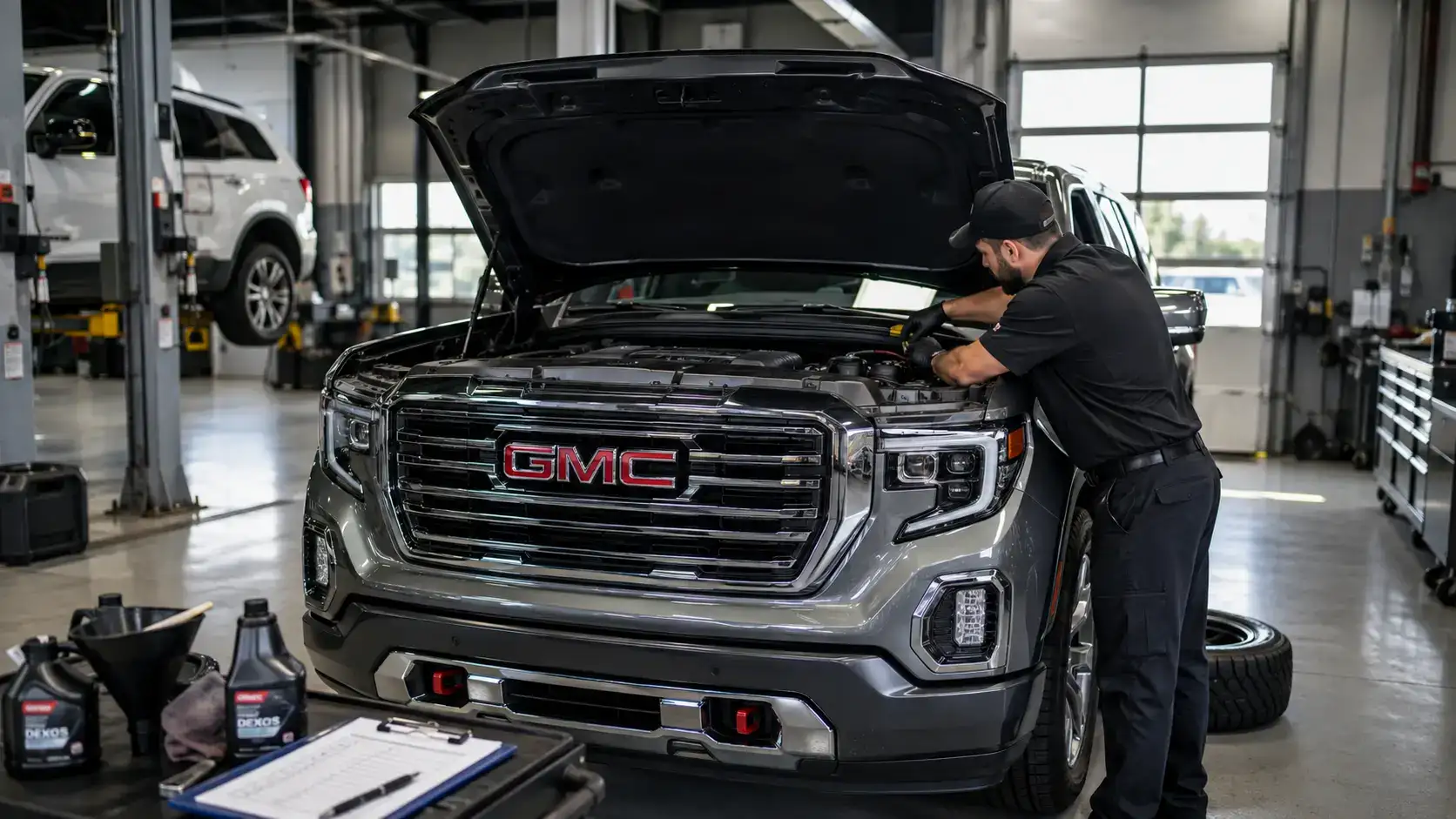
Maintaining a GMC on the correct service schedule is the single most effective action for preserving its reliability, protecting its warranty, and maximizing its resale value over the ownership period. Florida’s specific climate conditions, sustained heat from April through October, the high humidity that accelerates corrosion, and the intensive air conditioning use that loads engine cooling systems continuously, make some of the national maintenance schedule guidelines insufficient for our market. This guide covers the correct service intervals for every GMC model’s most important maintenance items, adjusted for the Central Florida climate and the specific use patterns of Osceola County drivers.
At Starling GMC’s certified service department at 1001 E Highway 192 in St. Cloud, we apply Florida-specific service recommendations rather than the minimum intervals that suffice in more moderate climates. This guide reflects those recommendations.
Understanding GMC’s Oil Life Monitor System
Every current GMC vehicle equipped with the Oil Life Monitor (OLM), which covers the full current lineup from Terrain to Sierra HD, uses an algorithm-based system to calculate remaining oil life based on the vehicle’s actual operating conditions: engine speed, engine load, temperature, and driving pattern. The OLM generates a percentage that reflects remaining oil life and triggers a ‘Change Engine Oil Soon’ notification at 10-20 percent remaining. It does not measure the oil directly, it models the oil’s degradation based on operating inputs.
The OLM is accurate under its design conditions. Its design conditions are based on national average driving patterns in moderate climates. Central Florida’s sustained heat, the heavy AC load, and the stop-and-go traffic patterns of US-192 and I-4 push engine operating conditions toward the demanding end of the OLM’s model range, meaning the actual oil degradation may be ahead of what the OLM calculates. This is the foundation for the Florida-specific interval recommendations below.
How Often to Change Oil in a GMC (Florida-Specific)
The national recommended maximum oil change interval for most current GMC vehicles is 7,500 miles for full synthetic oil or when the OLM reaches 10-20 percent, whichever comes first. In Florida’s climate, our service team at Starling GMC recommends maintaining a 5,000-mile interval for full synthetic oil or a 3,000-mile interval for conventional oil regardless of the OLM reading, and not allowing the OLM to reach below 15 percent before scheduling the oil change.
5.3L V8, 6.2L V8, and 2.7L TurboMax Intervals
The 5.3L V8 in the Sierra 1500 and Yukon: 5,000 miles between full synthetic oil changes in Florida driving conditions. The 6.2L V8 in Denali models: same 5,000-mile synthetic interval. The 5.3L’s AFM/DFM cylinder deactivation system specifically benefits from this more frequent interval because the lifters in the deactivation system are hydraulic and oil-condition-dependent, degraded oil increases the risk of lifter bore wear that produces the well-documented AFM/DFM tick and potential lifter failure. The 2.7L TurboMax in the Sierra 1500, Canyon, and Terrain: 5,000 miles for full synthetic. The turbocharger’s bearing lubrication is particularly oil-quality-dependent; turbo-equipped engines are the application where oil degradation matters most because the turbocharger’s bearing operates at temperatures that exceed what the oil cools through the engine’s circuitry, the hotter and more degraded the oil, the higher the turbo bearing wear rate. Use dexos1 Gen 3 approved full synthetic oil as specified in the owner’s manual for all turbo-equipped GMC engines.
Duramax Diesel Oil Change Intervals and DEF
The 3.0L Duramax in the Sierra 1500 and Yukon: 7,500 miles between oil changes is the national recommendation; our Florida recommendation is 5,000-6,000 miles due to the diesel engine’s more complex emissions system and the higher operating temperatures that Florida’s heat and sustained AC load create. The 6.6L Duramax in the Sierra HD: the same 5,000-6,000 mile interval applies for Florida operation. Use Dexos2 certified diesel engine oil as specified. Diesel Exhaust Fluid (DEF): the Duramax engines require DEF (a urea-based fluid) to operate the Selective Catalytic Reduction (SCR) system that reduces NOx emissions. DEF consumption is approximately 1 gallon per 500-800 miles, check the DEF level gauge on the infotainment system and replenish before the system generates a low-DEF warning. Ignoring a low-DEF warning will eventually limit the vehicle’s speed as an EPA compliance mechanism. DEF is available at our service department, most auto parts stores, and large fuel stations. Use only fluid that meets ISO 22241 specification.
Sierra EV and Electric Model Service
The Sierra EV, Hummer EV, and other electric GMC models do not require conventional oil changes, there is no combustion engine with motor oil. Electric motor lubrication is sealed-system gear oil that does not degrade at the same rate as engine oil. The primary fluid service items for electric GMC models: coolant inspection and replacement at manufacturer-specified intervals (typically every 5 years or 150,000 miles for the battery thermal management coolant); brake fluid inspection and replacement every 2 years regardless of mileage; and tire rotation at the standard 5,000-7,500 mile interval. The regenerative braking system in GMC EVs means brake pad wear is significantly lower than in gasoline vehicles, pads may last 70,000-100,000 miles or more, but brake fluid still absorbs moisture over time and should be replaced on the 2-year schedule.
Complete GMC Service Schedule (Beyond Oil Changes)
A comprehensive GMC maintenance plan covers more than oil changes. The items below represent the full service picture for current GMC vehicles in Central Florida conditions.
|
Service Item |
National Interval | Florida Recommendation | Why Florida Differs |
| Engine oil change (synthetic) | Every 7,500 mi or OLM | Every 5,000 mi |
Heat and AC load accelerate oil degradation |
|
Tire rotation |
Every 5,000-7,500 mi | Every 5,000 mi | Florida’s heat increases tire wear uniformity importance |
| Cabin air filter | Every 15,000-25,000 mi | Every 12,000-15,000 mi |
High pollen, dust, and humidity load on filter |
|
Engine air filter |
Every 30,000-45,000 mi | Every 25,000-30,000 mi | Florida’s particulate environment and AC system load |
| Brake fluid replacement | Every 2-3 years | Every 2 years |
Humidity accelerates brake fluid moisture absorption |
|
Coolant flush |
Every 5 years / 150,000 mi | Every 4 years | Heat cycling stresses coolant chemistry faster |
| Transmission fluid | Every 45,000-60,000 mi | Every 40,000-50,000 mi |
Towing in heat increases fluid degradation rate |
|
Battery inspection |
Annual | Every 6 months | Florida heat is the primary battery life limiter |
| Spark plugs (iridium) | Every 100,000 mi | Every 75,000-80,000 mi |
Heat cycling and AFM/DFM stress iridium plugs faster |
|
Tire pressure check |
Monthly | Monthly (especially seasonal) |
1 PSI per 10°F ambient change produces wide Florida swings |
Model-Specific Service Notes
Several GMC models have specific service considerations beyond the general schedule above.
Sierra 1500 with AFM / DFM: Watch for the Lifter Tick
The Sierra 1500’s Active Fuel Management (AFM) system on 5.3L V8 engines (2007-2018 generation) and Dynamic Fuel Management (DFM) on the current generation use hydraulic lifters that can collapse prematurely when oil quality is marginal or maintenance is deferred. The early symptom is an engine tick that appears on a warm engine at low RPM under light load, a noise that is distinct from normal engine sound and that increases slightly with engine speed.
When this tick appears: schedule a diagnostic appointment immediately rather than deferring. At its earliest stage, an AFM/DFM tick can be addressed with an oil change using fresh high-quality synthetic and potentially a lifter-specific additive; at later stages, the lifter failure progresses to cylinder and camshaft damage that requires significantly more expensive repair. The 5,000-mile synthetic oil change interval is the single most effective AFM/DFM preventive maintenance action.
Canyon 2.7L TurboMax: Let the Engine Cool Before Shutoff
Turbocharged engines benefit from a brief idling period after hard use, particularly after sustained high-RPM operation like highway passing or towing, that allows the turbocharger to cool before the oil circulation from the running engine stops. The Canyon’s 2.7L TurboMax’s turbocharger bearing operates at temperatures above what the engine oil alone can immediately dissipate after shutdown; a 1-2 minute cool-down idle period after hard use reduces the thermal stress on the turbo bearing oil film and extends turbo bearing life. Modern turbos in the TurboMax are more durable than older designs and many drivers do not experience turbo failure from immediate shutdown, but the brief idle is a low-cost habit that adds turbocharger longevity insurance.
Yukon 3.0L Duramax: DEF, DPF, and Annual Exhaust System Check
The Yukon Duramax’s diesel emissions system, the Diesel Particulate Filter (DPF) and Selective Catalytic Reduction system, requires specific service attention beyond the oil change interval. The DPF collects soot from the diesel combustion process and periodically ‘regenerates’ by burning off accumulated soot at high temperature, a process the engine management system initiates automatically during highway driving. Short-trip driving that does not allow the DPF to reach regeneration temperature can lead to DPF clogging. If the Yukon Duramax primarily makes short trips (under 10 miles), the service department recommends a 30-minute highway drive every 1-2 weeks to ensure DPF regeneration completes. The DEF system’s components, injector, tank, heating element in cold climates, should be inspected annually as part of routine Duramax service.
When to Use Synthetic vs Conventional Oil in Your GMC
Every turbocharged GMC engine, the 2.7L TurboMax in the Sierra 1500, Canyon, and Terrain; the Yukon’s available turbo configurations, requires full synthetic oil specified to dexos1 Gen 3 standard. No conventional oil is acceptable for these applications in GMC’s specifications. The 5.3L and 6.2L V8 engines require dexos1 Gen 3 synthetic or semi-synthetic, again, full synthetic is the Florida recommendation for the extended oil quality maintenance at the 5,000-mile interval. The Duramax diesel requires Dexos2 certified synthetic diesel engine oil. There is no cost-saving scenario that makes conventional oil the right choice in Florida’s climate for current GMC engines.
Tire Pressure and Rotation in Florida’s Climate
Tire pressure is the single most neglected maintenance item on Florida vehicles, and Florida’s ambient temperature swings create more TPMS activity per vehicle per year than most other states. The 1-PSI-per-10-degree-Fahrenheit relationship means that a properly inflated tire on a 72-degree morning reads 4-5 PSI higher on a 95-degree afternoon in direct sun, and 3-4 PSI lower than the morning pressure on a 60-degree overnight.
Checking tire pressure cold (after the vehicle has been parked for at least 3 hours) on a monthly basis and correcting to the door-jamb placard specification maintains the baseline rolling resistance and wear patterns that the EPA fuel economy estimates assume. Tire rotation every 5,000 miles in Florida is particularly important for even wear: the Terrain’s and Acadia’s front-wheel-drive configurations concentrate wear on the front tires from both steering and drivetrain duties; the Sierra’s rear-wheel-drive configurations wear the rear tires faster under acceleration and towing loads. Rotation balances this wear and extends the tire set’s life to its full potential mileage.
Schedule Your GMC Service at Starling GMC St. Cloud
Starling GMC’s certified service department at 1001 E Highway 192 in St. Cloud services all GMC models with GM-trained technicians, OEM-specified fluids and parts, and the diagnostic equipment required for current-generation GMC technology. For routine maintenance, oil changes, tire rotation, filters, our service team offers competitive pricing and typically same-day or next-day scheduling. For AFM/DFM diagnostic concerns on 5.3L V8 models, DEF system service on Duramax models, or any warranty-covered repair: our technicians have the specific training and equipment that the work requires.
Online service scheduling is available on our website. Walk-ins are welcome for oil changes and minor service during posted service hours. Contact our service department at 1001 E Highway 192 in St. Cloud for appointments, service pricing, and GMC warranty service.
Conclusion
Florida’s heat, humidity, and AC-intensive driving environment require adjustments to the national GMC service schedule that protect your vehicle against the climate’s specific wear accelerators. The most important Florida-specific adjustments: 5,000-mile synthetic oil changes (not the national 7,500-mile maximum), 2-year brake fluid replacement, 12,000-mile cabin air filter service, and 6-month battery inspections. The 5.3L V8 AFM/DFM lifter health is the most consequence-sensitive maintenance item for Sierra 1500 and Yukon V8 owners, the 5,000-mile oil change interval is the most effective preventive measure.
Duramax diesel owners should monitor DEF level regularly and ensure highway driving occurs frequently enough for DPF regeneration to complete. Sierra EV owners should prioritize tire rotation and 2-year brake fluid replacement in place of the oil changes that conventional vehicles require. Starling GMC at 1001 E Highway 192 in St. Cloud provides all GMC service with certified technicians and OEM parts.
Building a Florida-Specific Service Habit
The most effective GMC maintenance program in Central Florida is built around three consistent habits that cover the majority of preventive value available to any owner in this climate.
First, monthly tire pressure checks on the first morning of each month before the day’s heat builds, using the door-jamb placard cold-pressure specification. This single habit preserves the fuel economy, handling, and tire wear profile that the vehicle was engineered to provide, and in Florida’s climate where 15-degree daily temperature swings can shift pressure by 1.5 PSI, consistent monthly checking prevents the gradual underinflation that most owners never notice until a tire wears unevenly or a TPMS warning appears.
Second, an annual pre-summer inspection in April before the heat and storm season arrives in May, covering battery load test, cooling system condition, belt and hose inspection, and brake system review at the point when identifying a marginal component before failure is most financially efficient.
Third, an annual post-hurricane-season inspection in November covering any salt air exposure from storm conditions, corrosion check on brake lines and suspension components for vehicles kept near Osceola County’s waterways or the Space Coast, and tire sidewall inspection for any impact damage from seasonal road hazard conditions.
These three touchpoints, monthly pressure, pre-summer inspection, post-season inspection, combined with the oil change and rotation schedule established in this guide cover the vast majority of preventive maintenance value for any GMC owner in the St. Cloud area. Our certified service department at Starling GMC, 1001 E Highway 192 in St. Cloud, offers online scheduling, transparent service pricing, and same-day availability for routine maintenance to make following this schedule straightforward for busy Central Florida families.

0 comment(s) so far on GMC Oil Change & Service Schedule Guide